
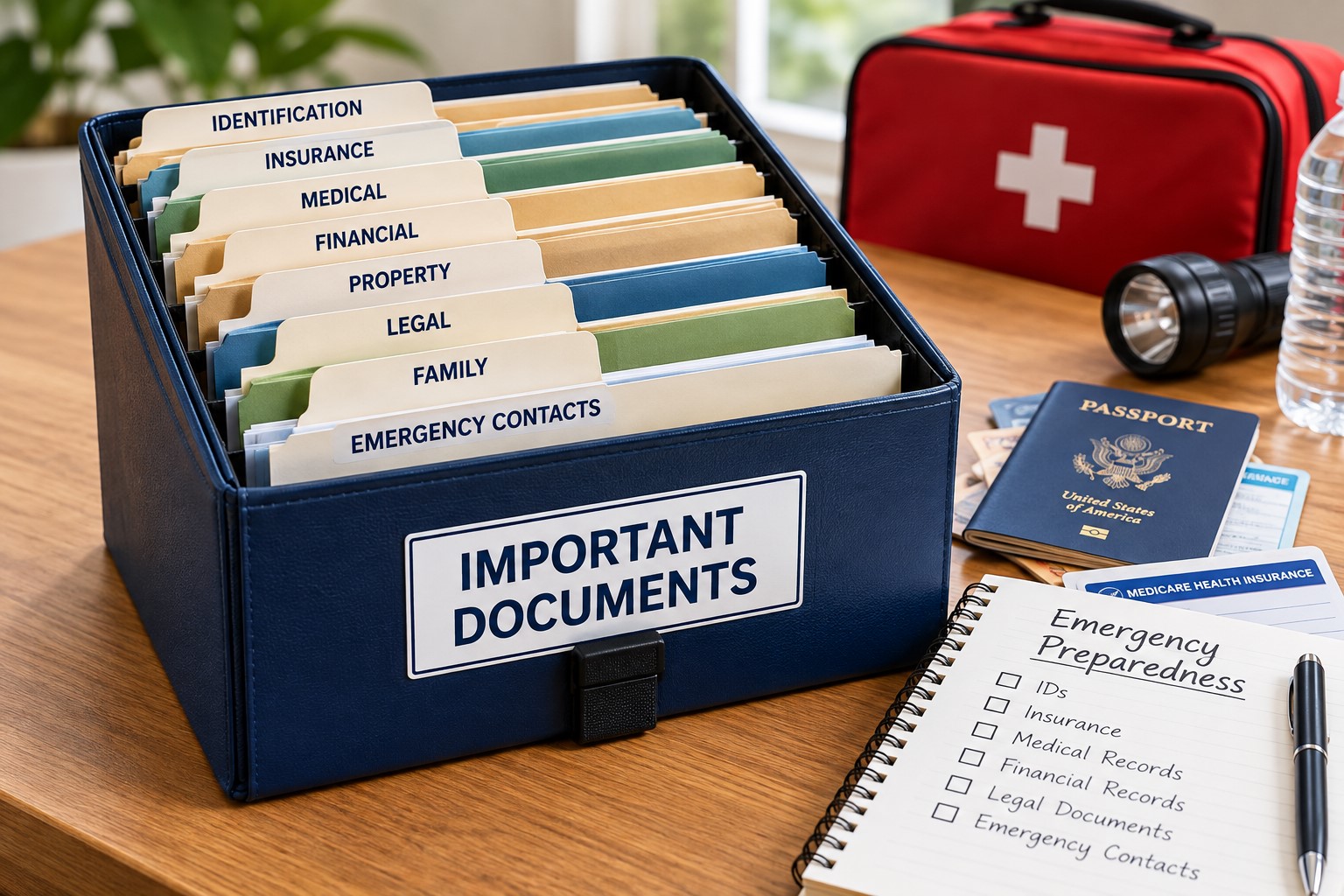
What Important Documents Should You Keep for an Emergency?
When an emergency forces you to leave home quickly, the documents you need may suddenly matter almost as much as the supplies you packed.
You may need to prove who you are, contact an insurance company, replace a prescription, show ownership of a vehicle or property, reach a family member, or deal with a financial account while you are away from home.
That does not mean carrying every important original document in a backpack by the front door. A better approach is to know which documents matter, where the originals are kept, which copies should be accessible, and how you could reach important information if your home or normal devices were unavailable.
Start With Documents That Prove Who You Are
Identification is one of the first categories to organize because many other tasks depend on it.
Useful records may include copies of a driver’s license or other government-issued photo identification, passport information, birth certificates, Social Security cards, immigration documents when applicable, and adoption or custody records that could become important during an emergency.
The CDC includes personal identification and vital records among the paperwork households should collect and protect as part of emergency preparedness.
You do not necessarily need every original document in a grab-and-go folder. Some originals are safer in a secure location. What matters is knowing where they are and having appropriate copies or identifying information available when needed.
Our Identity & Essential Documents guide can help you review this category beyond emergency preparation.
Keep Insurance Information Easy to Reach
Insurance becomes especially important after a fire, storm, accident, evacuation or other major event.
You may need health insurance information for medical care. Homeowners or renters insurance information may be needed after property damage. Auto insurance details may be important after an accident or evacuation involving a vehicle.
Keep enough information available to identify the insurer, locate the policy and contact the appropriate claims department.
The FTC recommends organizing insurance information along with other important financial and family records before a disaster occurs.
You can use the Insurance Documents Checklist to review the insurance records you currently have and identify anything that may be missing.
Do Not Forget Medical Information
An emergency document file should not become a complete medical archive. It should contain or point you toward the information someone may genuinely need if normal routines are interrupted.
That can include health insurance information, a current medication list, allergy information, important medical contacts, advance directives when applicable, and information needed to operate important medical equipment.
The CDC specifically recommends preparing insurance cards, medical records, advance directives and relevant care plans as part of emergency paperwork.
Keep this information current. A medication list that has not been updated in several years may create more confusion than help.
For broader planning, review our Health & Medical Readiness guide.
Financial Records Matter Too
You may not think of financial paperwork as emergency equipment, but access to money can become more difficult when banks, ATMs, mail service, power or internet access are disrupted.
You do not need to carry complete bank statements around with you. Instead, think about the information you would need to identify accounts, contact financial institutions, continue important payments or begin replacing lost records.
The FTC advises households to organize important financial records and maintain accessible backups of financial information before a disaster.
This is also a good reason to keep your overall financial system organized before an emergency ever happens. Our Money section covers the broader financial foundation.
Include Property and Ownership Records
After major property damage, documentation can help you explain what you owned and what was affected.
Home deeds, vehicle titles and other ownership records may be important, but a household inventory can be just as valuable.
Walk through your home periodically and photograph or record major possessions. Keep copies of receipts or serial numbers for particularly valuable items when practical.
The FTC recommends creating a household inventory with photos or video because it may help when filing an insurance claim after a disaster.
Your inventory does not have to be complicated. A simple room-by-room record that is updated periodically is far better than trying to remember everything after something has already happened.
Legal and Family Documents Can Become Important Quickly
Emergencies can affect more than property.
Documents involving marriage, children, caregiving, estate planning or decision-making authority may suddenly become important when someone is injured, displaced or unable to handle matters personally.
Depending on your household, relevant records may include marriage certificates, adoption or custody documents, wills, powers of attorney, advance directives and other important family or legal records.
The goal is not to carry your entire legal file with you. It is to know what exists, where the original is kept and who would need access if you could not retrieve it yourself.
Our Legal & Estate Planning guide can help you review this area in more detail.
Have Emergency Contacts Outside Your Phone
Phones are convenient until the battery dies, the device is damaged or you cannot access it.
Keep a short written emergency contact record that includes the people you would need most, along with important professional contacts when appropriate.
That could include close family members, an emergency contact outside your immediate area, doctors, an insurance agent, attorney, veterinarian, employer or another person important to your household.
You do not need to create a giant directory. The purpose is to make the most important numbers available even when your normal contact list is not.
Our Emergency Contact Card can help you create a simple version.
Originals, Copies and Digital Backups Serve Different Purposes
One of the biggest mistakes is assuming every important document belongs in the same place.
Some originals are difficult to replace and may belong in a secure fire-resistant location or another appropriate protected location. Copies of frequently needed information can be kept in a more accessible emergency file.
Digital backups add another layer.
The FTC recommends protecting important documents through approaches such as secure online storage or protected digital backups, while also emphasizing strong passwords and multifactor authentication.
This is where redundancy helps. If the only copy of an important document is on a computer inside your home, a house fire could destroy both the paper record and the backup at the same time.
A better system separates the copies.
Be Careful About What You Put in an Emergency Folder
Accessibility and security have to work together.
An emergency folder that contains every password, complete bank account information, Social Security numbers, credit card details and other highly sensitive information can create a serious problem if the folder is lost or stolen.
Keep only the information needed for the purpose of the emergency file.
For particularly sensitive records, it may be better to keep a note indicating where the record is securely stored rather than placing the complete information in an easily portable folder.
That same principle is behind our Where Things Are Worksheet. Sometimes the most useful information is simply knowing where an important item can be found.
Think About What You Could Grab in Five Minutes
Emergency planning becomes easier when you make it practical.
Imagine you had five minutes to leave your home and did not know when you would return.
Would you know where your identification was?
Could you locate your insurance information?
Could another family member find the legal or medical records they might need?
Could you contact your financial institutions if your wallet or phone disappeared?
Would you know how to reach important information if your home computer was unavailable?
Those questions reveal weaknesses much faster than simply asking, “Do I have my documents?”
Review Your Emergency Documents Once a Year
Documents change.
Insurance policies renew. Medications change. Passports expire. People move. Beneficiaries change. New accounts are opened. Vehicles are replaced. Children grow up. Family responsibilities shift.
The FTC recommends reviewing emergency financial records and related storage at least annually so information remains current.
You can make this part of your Annual Life Review rather than creating another separate maintenance routine.
A major life event is also a good reason to review the file. Marriage, divorce, moving, buying a home, having a child, retirement, becoming a caregiver or the death of someone close can all change which documents matter and who needs access.
Your Emergency Document System Does Not Need to Be Complicated
A useful system can be surprisingly simple.
Know what the important documents are. Protect the originals appropriately. Keep useful copies accessible. Maintain a secure backup. Make sure another trusted person knows where essential information can be found. Review everything periodically.
The goal is not to create more paperwork.
The goal is to avoid standing in the middle of an already difficult situation trying to remember where everything is.
Ready to Review the Rest of Your Emergency Setup?
Important documents are only one part of being prepared.
Our Emergency Preparedness guide can help you review communication, supplies, records, household needs and other areas that may deserve attention.
For a broader look at everything you may want to have in place, start with the Prepared Life Checklist.
Sources
This article was informed by emergency-paperwork and disaster-readiness guidance from the U.S. Centers for Disease Control and Prevention and the Federal Trade Commission. CDC guidance emphasizes protecting identification, insurance information, vital records and relevant care plans. FTC guidance covers household inventories, financial and family records, secure storage and digital backups.